The acoustic ceiling baffle doing double duty in high-traffic spaces.

Acoustic management in commercial buildouts usually falls into one of two traps, it’s either completely ignored until a space’s echoes to hold a meeting, or it is tacked on after the fact as an unsightly afterthought.
The most thoughtful spaces treat acoustic performance and aesthetic design as the exact same line item.
Take a felt wall system with a backlit reveal in a high-traffic reception or lounge area. Wool felt panels absorb sound far more effectively than painted gypsum board, particularly in rooms with hard flooring and reflective ceilings. By breaking the panels into vertical bays with wood battens and integrating a lit reveal at the top edge, the acoustic dampening becomes the primary feature finish rather than something hidden in the background.
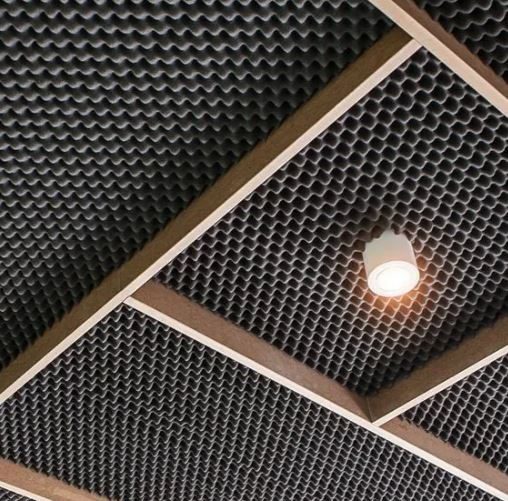
The same principle applies to the ceiling plane. In an open plan space, an untreated ceiling turns every conversation into ambient noise for the entire floor. Utilizing a perforated, foam core tile system with recessed downlights handles noise control at the structural layer. Because the lighting is integrated directly into the panel rather than surface mounted on top, the ceiling retains a clean design aesthetic while silently absorbing sound.
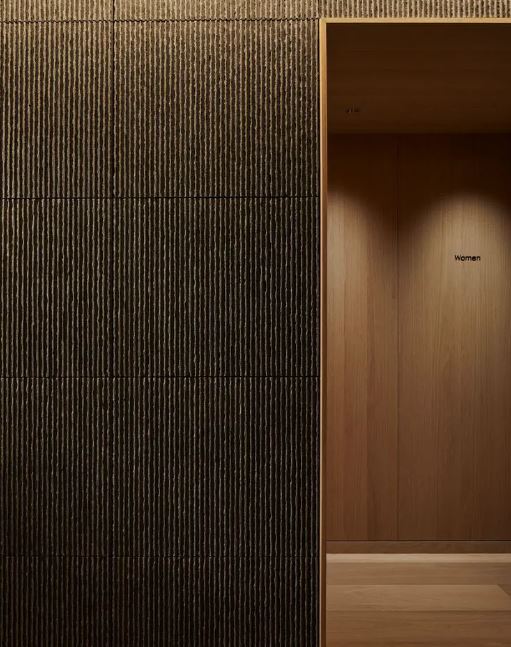
Even transitional spaces benefit from this dual purpose approach. A hard floored corridor naturally carries noise straight down the hall, but installing fluted wood acoustic cladding breaks up those sound reflections. When paired with a matching solid wood door and integrated wayfinding signage, the grooved wood-slat panels read as a continuous, high-end wall finish rather than a bolted-on acoustic panel.
THE TAKEAWAY:
None of these elements look like traditional acoustic treatment at first glance, and that is precisely the point. When the ceiling, wall, and cladding perform heavy sound-absorption work while functioning as the visible finish layer, acoustic performance isn’t an added cost or a design compromise, it’s built in from the start.
 BUILT TO NOTICE